On this page
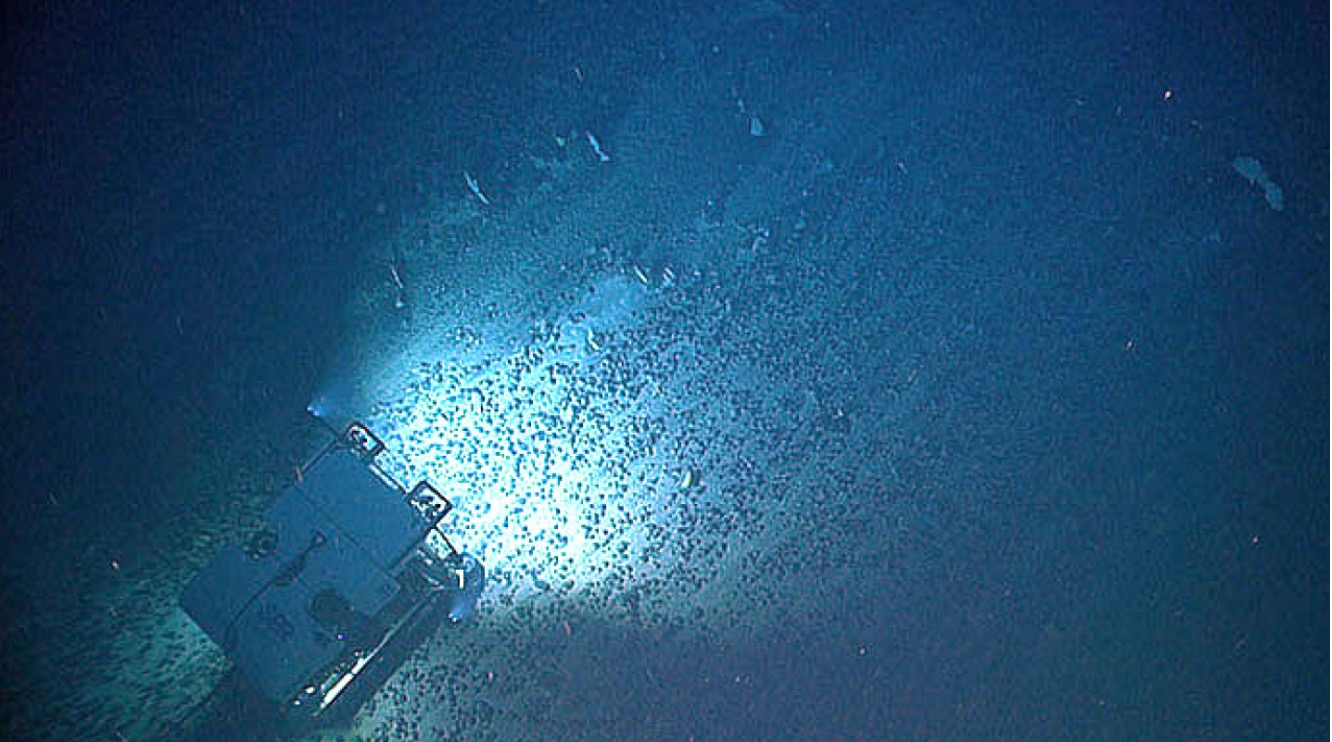
Start with what is not happening: nobody is mining the deep seabed commercially, and the rules that would allow it are unfinished. Everything else on this page is the case for and against, and the machinery that will decide it. The idea is the same as Cornish stream tin, lifting heavy minerals out of sediment, only at depths of several kilometres. The deep-sea mining hub collects the regulators, the zones and the rules.
What deep-sea mining means
Deep-sea mining is the process of retrieving mineral deposits from the deep seabed, the ocean below 200 m. In practice the target is much deeper: the nodules of economic importance occur mostly at 4,000 to 6,000 metres. The deep seabed covers about two-thirds of the total seafloor. Deposits lie hundreds or even thousands of metres below the surface and hold copper, cobalt, nickel, zinc, silver, gold and rare earth elements.
Mining there comes in three stages: prospecting, exploration and exploitation. Exploration contracts exist today. Exploitation does not, and deep-sea mining has not yet been undertaken commercially.
The minerals it targets
Three kinds of deposit matter. Nodules are potato-sized lumps on the seabed; polymetallic sulphides are large deposits that form around hydrothermal vents; and metal-rich crusts coat underwater mountains called seamounts.
Nodules are the current focus in international waters. They cover vast areas of the ocean floor and are most abundant in the Clarion-Clipperton Zone, the Central Indian Ocean Basin and the Peru basin. The nodules vary from micro-nodules to about 20 cm, with two to eight centimetres the common size. The deposits of economic importance occur mostly at 4,000 to 6,000 metres depth. Nickel, copper, cobalt and manganese are the metals attracting interest.
Nodules grow slowly. They accrete at rates of 1 to 15 mm per million years. The Clarion-Clipperton Zone alone contains over 21 billion metric tons of nodules, with minerals such as copper, nickel, cobalt and manganese making up roughly 30% of their weight.
How it would be done
The proposed method is a seabed vacuum. Mining vehicles would remove mineral deposits from the surface of the seabed, along with the top layers of sediment, using a suction device not unlike a vacuum cleaner. The material would then be piped up to a surface vessel for processing. Waste such as sediment would be pumped back into the water column.
Small-scale precedents exist. In the 1970s Shell, Kennecott and Sumitomo recovered over ten thousand tons of nodules in pilot tests in the Clarion-Clipperton Zone. Japan’s JOGMEC carried out the first large-scale mining of hydrothermal vent deposits from August to September 2017.
Who regulates it: the Area, the ISA and UNCLOS
The legal starting point is the Law of the Sea Convention. The Convention defines the Area as the seabed and ocean floor and subsoil beyond the limits of national jurisdiction. The Area and its resources are the common heritage of mankind. No State may claim or exercise sovereignty or sovereign rights over any part of the Area. Activities there must be carried out for the benefit of mankind as a whole.
The International Seabed Authority (ISA) is the body that runs the system. The ISA is an autonomous international organization established under the 1982 Convention and the 1994 Agreement on Part XI. It came into existence on 16 November 1994 and is based in Kingston, Jamaica. As of 6 February 2026 it had 172 members, 171 states plus the European Union. The Area covers around 54 per cent of the world’s oceans.
Activities follow a contract. They must be carried out under a formal written plan of work approved by the Council after review by the Legal and Technical Commission. The ISA has entered into 15-year exploration contracts with 22 contractors.
The Mining Code
The ISA’s rulebook is called the Mining Code. It comprises rules, regulations and procedures to regulate prospecting, exploration and exploitation of marine minerals in the Area. Three sets of exploration regulations are in place. Exploitation rules are not: the ISA has been developing them since 2014, and the Legal and Technical Commission submitted draft regulations to the Council in 2019.
The draft exploitation regulations are still under negotiation by the Council. A road map approved in July 2023 aimed at adoption during 2025. That target was missed. On 24 July 2026, at the end of the second part of its 31st session, the Council asked the Secretariat for a road map setting out milestones for the timely adoption of the rules, and its decision opens by reiterating that commercial exploitation should not be carried out in the absence of rules, regulations and procedures. The Secretariat’s draft road map is due by 31 October 2026. The ISA guide has the session-by-session record. Opinion remains deeply divided on whether deep-sea mining should be allowed at all.
Outside the ISA: national licences and the US route
Some countries are looking at the seabed in their own exclusive economic zones. The Cook Islands announced three five-year exploration awards in February 2022. In December 2024 Norway’s plans to begin awarding exploration areas were temporarily put on hold.
The United States takes a separate route. The US is not a party to the Law of the Sea Convention. NOAA is charged under the Deep Seabed Hard Mineral Resources Act with issuing licences for exploration and permits for commercial recovery of nodules to US companies. Under that Act the US may issue such licences in areas beyond national jurisdiction if all statutory and regulatory requirements are met. On 24 April 2025 an executive order set policies to advance US leadership in seabed mineral exploration.
The first US application
The one to watch. On 19 August 2026 NOAA announced that the consolidated application of The Metals Company USA for an exploration licence and a commercial recovery permit is in full compliance with the information requirements of the Deep Seabed Hard Mineral Resources Act. It covers proposed activities in the Clarion-Clipperton Zone. NOAA’s comment period concluded on 19 October 2026, and if NOAA certifies the application it would then evaluate the environmental impacts through an environmental impact statement. In March 2026 several delegations at ISA expressed concern about the possibility of unilateral action to authorize seabed mining. The Clarion-Clipperton Zone guide covers the area itself.
NOAA’s final rule
The rules behind it are new: on 21 January 2026 NOAA issued its final rule, revising the regulations for exploration licence and commercial recovery permit applications. NOAA’s page lists no existing commercial recovery permits. UNCLOS prohibits unilateral mining activities, and contractors may have exploration contracts revoked if found to be in violation.
Who is involved
Originally, exploration was mostly undertaken by national agencies until 2010, when private companies became involved. The Metals Company also controls two further ISA exploration licences in the Clarion-Clipperton Zone, through Kiribati-based Marawa Research and Exploration and its Tongan subsidiary. In March 2025 it began applying for licences and permits under the NOAA code. Lockheed Martin holds two US exploration licences issued in 1984.
The record of earlier ventures is mixed. Nautilus Minerals filed for bankruptcy and was liquidated, after having difficulty raising money in December 2017.
What the debate is about
Supporters point to demand. Proponents argue that deep-sea mining can help meet the world’s pressing need for critical minerals. Demand for nickel, cobalt and rare earth elements may double by 2040 in a net-zero emissions scenario. The IUCN lists metals such as copper, nickel, aluminium, manganese, zinc, lithium and cobalt as depleting on land.
Critics point to the risks. The IUCN’s issues brief concludes that deep-sea mining could severely harm marine biodiversity and ecosystems, and that we still lack the knowledge and means to implement protections. Only 24.9% of the deep seabed has been mapped. The IUCN names three impacts. The most direct is disturbance of the seafloor, and the damage is most likely permanent. Sediment plumes come next, and scientists are concerned the particles may disperse for hundreds of kilometres. The third is pollution: whales, tuna and sharks could be affected by noise, vibrations and light, and by leaks and spills.
Nodules take a long time to replace. They may take millions of years to develop to a harvestable size, and they are an important habitat for deep-sea species. Waste discharge from mining vessels could spread kilometres from the mined area, though more research is needed on the plumes.
Positions on the answer differ. Germany, Canada and the European Parliament have called for national and regional moratoria, and Portugal banned the practice in its national waters for 25 years. Greenpeace UK reports that more than 700 scientists from 44 countries signed an open call to pause deep sea mining. Others argue land resources appear sufficient to meet global needs. Scaling up recycling could reduce the need for newly mined copper and nickel by 40% by 2050.
Where the caution is coming from
The IUCN argues for caution first. Its members adopted Resolution 122 for a moratorium on deep-sea mining unless and until a number of conditions are met. The conditions include the Precautionary Principle and the Polluter Pays Principle being implemented.
Governments have moved too, and the UK is one of them. It restated its position in a written answer in September 2025: it supports a moratorium on the granting of exploitation contracts by the ISA, and will not sponsor or support any until there is sufficient scientific evidence and strong enforceable environmental regulations, standards and guidelines are in place. The UK government announced the policy on 30 October 2023. It will not sponsor or support such licences until sufficient scientific evidence exists to assess the impact on marine ecosystems and strong, enforceable environmental regulations are adopted. It also announced a new UK-based environmental science expert network on deep sea mining.
The short version of the record: pilot mining has happened, and the rules to allow commercial mining have not been adopted. If you want the legal side first, the ISA guide is the page to open. For how UK licensing works at home, read the UK marine licence guide. For seabed tin at the shallow end of the scale, see offshore tin mining in Cornwall.
Common questions
What is the meaning of deep-sea mining?
Deep-sea mining is the process of retrieving mineral deposits from the deep seabed, the ocean below 200 m. The deep seabed covers about two-thirds of the total seafloor. The three stages are prospecting, exploration and exploitation.
What companies are doing deep-sea mining?
No company is mining commercially yet. Contractors hold exploration contracts from the International Seabed Authority, 22 in all, and The Metals Company controls two further exploration licences in the Clarion-Clipperton Zone through Kiribati-based and Tongan subsidiaries. Lockheed Martin holds two US exploration licences issued in 1984.
What are the three impacts of deep-sea mining?
The IUCN names three main impacts: disturbance of the seafloor, sediment plumes and pollution from noise, light, leaks and spills. Seafloor damage is the most direct impact and is most likely permanent.
Who regulates deep-sea mining?
In the Area, the International Seabed Authority organises and controls mineral activities on behalf of humankind. In their own waters, countries set their own rules. The US, which is not a party to the Law of the Sea Convention, licenses its companies through NOAA.
Is deep-sea mining allowed in the UK?
No commercial deep-sea mining is happening, and the UK government supports a moratorium on the granting of exploitation contracts by the ISA, as it restated in a written answer in September 2025. It will not sponsor or support such contracts until there is sufficient scientific evidence and strong enforceable environmental rules are in place. The UK first announced the position on 30 October 2023.
Read next
Tin from the sea
Offshore Tin in Cornwall: Is Anyone Dredging the Seabed, and What Would It Do?
Is tin being dredged off Cornwall? What seabed tin is, whether a licence application is open, what dredging does and how the public can comment.
UK marine licensing
UK Marine Licence Explained: Who Needs One, Who Grants It and What It Costs
How a UK marine licence works: the activities that need one, the MMO and the other regulators, the application steps, fees, conditions, appeals and penalties.
Deep-sea mining
International Seabed Authority (ISA): What It Does, Who Belongs and How It Is Funded
What the International Seabed Authority does, how its organs work, its 172 members, exploration contracts, funding and draft mining rules.
Sources
- What We Know About Deep-Sea Mining and What We Don't · World Resources Institute · wri.org · checked 20 October 2026
- Deep-sea mining (issues brief) · IUCN · iucn.org · checked 20 October 2026
- Deep Seabed Hard Minerals Mining · NOAA National Ocean Service · oceanservice.noaa.gov · checked 20 October 2026
- About ISA · International Seabed Authority · isa.org.jm · checked 20 October 2026
- Exploration Contracts · International Seabed Authority · isa.org.jm · checked 20 October 2026
- Minerals: Polymetallic Nodules · International Seabed Authority · isa.org.jm · checked 20 October 2026
- The Mining Code · International Seabed Authority · isa.org.jm · checked 20 October 2026
- Draft exploitation regulations · International Seabed Authority · isa.org.jm · checked 20 October 2026
- United Nations Convention on the Law of the Sea · United Nations · un.org · checked 20 October 2026
- UK supports moratorium on deep sea mining to protect ocean and marine ecosystems · Defra, FCDO and DBT (GOV.UK) · gov.uk · checked 20 October 2026
- Deep sea mining · Wikipedia · en.wikipedia.org · checked 20 October 2026
- Deep sea mining · Greenpeace UK · greenpeace.org.uk · checked 20 October 2026
- Decision ISBA/31/C/38 (24 July 2026) · International Seabed Authority · isa.org.jm · checked 21 October 2026
- ISA Council advances negotiations on the Mining Code (19 March 2026) · International Seabed Authority · isa.org.jm · checked 21 October 2026
- NOAA advances review of first-ever deep seabed mining commercial recovery application · NOAA · noaa.gov · checked 21 October 2026
- Deep Seabed Hard Minerals Mining (NOAA, current page) · NOAA · oceanservice.noaa.gov · checked 21 October 2026
- Written question 69209 on deep sea mining (answered 1 September 2025) · UK Parliament · questions-statements.parliament.uk · checked 21 October 2026
- ISA Council concludes second part of its 30th session (15 August 2025) · International Seabed Authority · isa.org.jm · checked 21 October 2026
Rules, fees and prices change: each source shows the date it was read. How we check facts · Report an error · Back to top.